For a long time, I thought my struggles were due to not having enough discipline. I often started new workout routines, stuck with them for a few weeks, and then lost motivation. I tried Noom, alternate-day fasting, and protein-shake diets. I saw some early progress, but once the excitement faded and my dopamine levels dropped, I stopped.
I believed that trying harder or finding more motivation would help me stay consistent, but that turned out to be wrong.
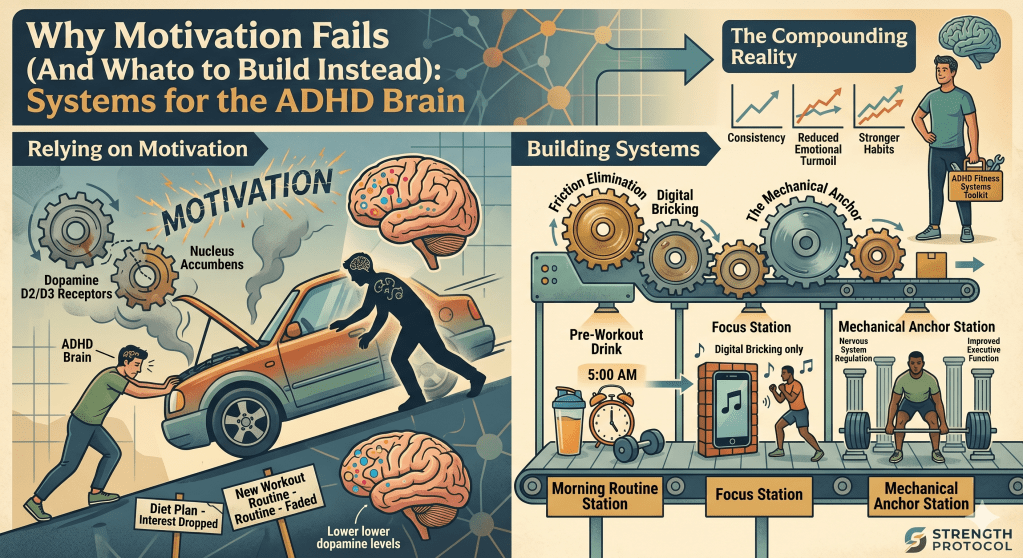
People with ADHD often have trouble relying on their own motivation because of how their brains handle dopamine. Trying to depend on motivation for fitness is like driving a car with a bad ignition—it might work sometimes, but it often leaves you stuck and tired.
This article looks at why motivation doesn’t work well for neurodivergent people and offers advice on building strong external systems that don’t depend on how you feel.
Section 1: Why Motivation Fails for ADHD Brains
The fitness industry often acts as if everyone experiences desire, reward, and action in the same way. But that’s not how our brains actually work.
The Dopamine Drop-Off
To see why people start strong and then lose steam, it helps to look at the brain itself. ADHD involves less dopamine activity in the prefrontal cortex and striatum, which are the parts of the brain that handle motivation, reward prediction, and starting tasks.[1][2][3]
When someone without ADHD sets a goal and acts on it, their brain releases steady dopamine, creating a lasting feedback loop. But people with ADHD get less dopamine during routine tasks, so there’s no chemical reward for sticking to a plan.
Studies using PET scans show that adults with ADHD have much lower dopamine D2/D3 receptor levels in the nucleus accumbens and midbrain, which are key parts of the brain’s reward system.[2][3] This change in the dopamine system explains why people with ADHD struggle with motivation, can’t delay gratification, and often prefer immediate rewards over waiting.[2]
The Interest-Based Nervous System
People without ADHD are motivated by tasks that matter in the long run. Those with ADHD, though, are mostly driven by things that are new or exciting.
Starting a new fasting plan or workout feels exciting at first. By the third week, that excitement fades, dopamine drops, and it’s hard to keep going. You can’t just think your way past a brain chemistry problem.
Research shows that people with ADHD have less activity in the ventral striatum when processing rewards. Their attention problems are worst during boring, repetitive tasks that don’t feel rewarding.
Section 2: The External Systems Principle
If your motivation isn’t reliable, you can stay consistent by relying less on your own willpower and building outside systems to help.
An external system is something in your environment that helps guide your actions, so you don’t have to depend so much on your brain’s decision-making. This takes away the need to make choices and lessens the pressure to use willpower.
When my alarm goes off at 5:00 AM, I don’t have to think about working out. My pre-workout drink is next to my bed, water is ready, and my headphones and gym clothes are already in the gym. My phone is turned off from the night before, so I won’t get distracted during exercise.
This setup makes things easier and lets external systems help with the challenges caused by biology.
Section 3: The Core Neurobiological Architecture
To help the neurodivergent brain stay steady and consistent, build certain key external supports.
System 1: Friction Elimination
Executive dysfunction means that even small things, like finding your gym shoes, can throw you off. It’s important to set up your environment ahead of time. If your workout clothes are already in the gym and your pre-workout is by your bed, it’s much easier to get started.
System 2: Digital Bricking
Smartphones give instant stimulation that can compete with tough habits. If you can reach your phone during workouts, your brain might just start scrolling instead. It helps to turn off your phone the night before or use strong app blockers, so it only plays music and doesn’t distract you.
System 3: The Mechanical Anchor
The gym isn’t just for getting stronger—it also helps regulate your nervous system. Heavy exercises like deadlifts and bench presses can become daily anchors.
Meta-analyses show that exercise has small to moderate benefits for ADHD symptoms and bigger effects on executive function. These interventions help kids and teens with ADHD, and the results depend on how intense the exercise is, what kind it is, and how often it’s done.
Combine heavy workouts with the right medical treatments, like targeted medication. The changes in the brain are significant. After a few weeks of regular heavy exercise, internal distractions go down. The tension from these movements gives your brain the input it needs to plan, focus, and build new habits.
Section 4: The Compounding Reality
Switching from relying on motivation to using systems leads to results that go beyond just physical changes. These strategies build up over time and start to change how your brain works.
For me, the biggest impact of ADHD used to be emotional ups and downs, not just stopping diets. As I stuck with these strategies, my overall mood got better.
I’m less angry now. When things go wrong, I don’t spiral or freeze. Internal distractions are lower, and my external systems handle the challenges. I can deal with changes more easily.
Things like a richer environment, mental training, and exercise have big effects on how the brain grows and works. Regular exercise helps the brain change and may boost executive function more than traditional treatments.
The Next Step
If you’re an adult who was diagnosed with ADHD later in life and you’ve struggled to stay consistent, you don’t need to try harder. Instead, stop depending on your brain’s chemistry and start building strong external systems.
Download the ADHD Fitness Systems Toolkit to get step-by-step templates and friction-mapping guides you can use to build your foundation today.
Join the https://www.skool.com/strength-protocol-4812/about to meet other neurodivergent adults who have stopped fighting their biology and started building systems that really work.
Dylan Kratochvil, MSN, NP-C
© Strength Protocol
References
- Attention-Deficit Hyperactivity Disorder. Posner J, Polanczyk GV, Sonuga-Barke E. Lancet (London, England). 2020;395(10222):450-462. doi:10.1016/S0140-6736(19)33004-1.
- Evaluating Dopamine Reward Pathway in ADHD: Clinical Implications. Volkow ND, Wang GJ, Kollins SH, et al. JAMA. 2009;302(10):1084-91. doi:10.1001/jama.2009.1308.
- Motivation Deficit in ADHD Is Associated With Dysfunction of the Dopamine Reward Pathway. Volkow ND, Wang GJ, Newcorn JH, et al. Molecular Psychiatry. 2011;16(11):1147-54. doi:10.1038/mp. 2010.97.
- Meta-Analysis of the Effects of Physical Activity on Executive Function in Children and Adolescents With Attention Deficit Hyperactivity Disorder. Song Y, Fan B, Wang C, Yu H. PloS One. 2023;18(8):e0289732. doi:10.1371/journal.pone.0289732.
- Chronic Exercise for Core Symptoms and Executive Functions in ADHD: A Meta-Analysis. Huang H, Jin Z, He C, et al. Pediatrics. 2023;151(1):e2022057745. doi:10.1542/peds. 2022-057745.
- Beyond Binary Comparisons: A Bayesian Dose-Response Meta-Analysis of Exercise on Executive Function in Children and Adolescents With ADHD. Pan Q, Zheng S, He P. Pediatric Research. 2026;99(4):1296-1305. doi:10.1038/s41390-025-04325-1.
- Effect of Physical Activity Interventions on Executive Functions in School-Age Children With ADHD: A Meta-Analysis of Randomized Controlled Trials. Li D, Miao C, Wang D, Li C. Journal of Affective Disorders. 2025;378:175-190. doi:10.1016/j.jad.2025.01.155.
- The Impact of Exercise Interventions Concerning Executive Functions of Children and Adolescents With Attention-Deficit/Hyperactive Disorder: A Systematic Review and Meta-Analysis. Liang X, Li R, Wong SHS, Sum RKW, Sit CHP. The International Journal of Behavioral Nutrition and Physical Activity. 2021;18(1):68. doi:10.1186/s12966-021-01135-6.
- The Influences of Environmental Enrichment, Cognitive Enhancement, and Physical Exercise on Brain Development: Can We Alter the Developmental Trajectory of ADHD?. Halperin JM, Healey DM. Neuroscience and Biobehavioral Reviews. 2011;35(3):621-34. doi:10.1016/j.neubiorev.2010.07.006.
 Strength Protocol
Leave a comment