Last month, I took a closer look at my own ADHD tax. I realized it was a lot more than just some overdraft fees.
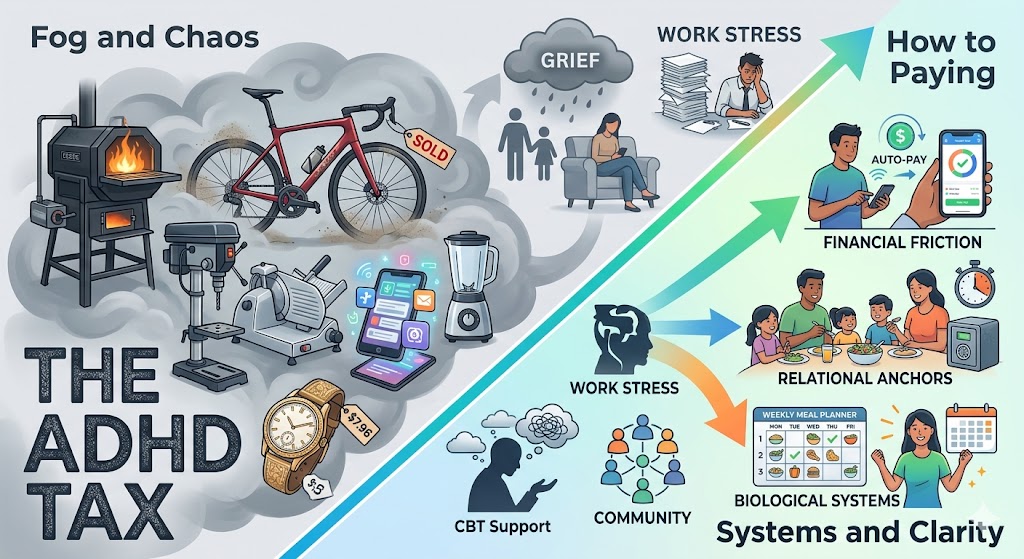
My list included a forge I never used, a road bike that was more expensive than my first car dust, a drill press, a professional meat slicer, a second blender, a stack of forgotten app subscriptions, and a brand-new watch I really didn’t need.
But losing money is just one part of it. The real cost is harder to see: realizing that the whole past year felt like a “fog” because I wasn’t really present.
The “ADHD tax” is the total cost of executive dysfunction, including financial, relational, professional, and psychological effects. For those of us diagnosed as adults, this tax has been building up for years.
In this post, I’ll help you look at your own ADHD tax, understand where it comes from in the brain, and build systems to help you stop paying it. I’ll share practical tips for managing money, improving relationships, and creating routines that save energy and lower stress. Knowing these steps ahead of time can help you figure out where to start making real changes.
The Financial ADHD Tax
When your brain is seeking dopamine, chasing new things can become an experience. For years, these impulse buys weren’t just random shopping sprees. They were ways to try to buy a new identity or find motivation. The forge, the meat slicer, the bike—each one felt like the thing that would finally make life work. Finally, make life work.
The financial burden of ADHD is substantial and well-documented. Adults with ADHD incur an estimated $2,591 more in annual medical expenditures compared to those without ADHD, with prescription medications accounting for the largest portion.[1] The total societal excess cost attributable to ADHD in the United States is approximately $122.8 billion annually ($14,092 per adult), with unemployment costs comprising 54.4% of the total, followed by productivity loss at 23.4%.[2] Globally, per-person costs range from $831 to $20,538, with national estimates ranging from $356 million to $20.27 billion.[3]
The neurobiological basis for this financial burden lies in aberrant novelty processing within the dopaminergic system. Adults with ADHD demonstrate heightened novelty signaling in the substantia nigra/ventral tegmental area, leading to greater selection of novel options even when they are suboptimal.[4] This heightened novelty-seeking is not simply a personality quirk—it reflects dopaminergic mesolimbic dysfunction that drives impulsive decision-making and reward-seeking behaviors.[5]
The financial ADHD tax shows up in a few clear ways:
- Impulse purchases: Buying professional-grade equipment for hobbies that last three weeks. Research confirms that adults with ADHD report significantly more impulsive buying and use more avoidant or spontaneous financial decision styles compared to those without ADHD.[6]
- Late fees and penalties: These happen when we forget things or lose track of time.
- Abandoned subscriptions: These are the monthly charges for apps and memberships we forgot about.
Action Step: Add up your own financial ADHD tax from the past 30 days. Check your bank and credit card statements for surprise expenses or impulse buys. Include late fees, forgotten subscriptions, and any unplanned spending. Seeing the numbers might be tough, but it’s the first step toward change. If you feel overwhelmed or discouraged, know that these feelings are normal. Many of us have been there. What matters is that being aware gives you the power to start changing things, one small step at a time.
The Relational ADHD Tax
This is the hardest tax to measure, and it’s often the most painful.
Before I understood my brain, I spent a lot of time with my family but wasn’t really present. Sometimes I was glued to my phone, lost in a game, or zoned out while my kids played nearby.
My wife, Katie, managed the house while I sat on the couch, feeling like a ghost. The relational tax is that heavy feeling when your partner has to do everything alone, and the guilt that comes from realizing you’ve been distant from your kids.
ADHD significantly affects interpersonal relationships and family functioning. Adults with ADHD experience elevated interpersonal conflict, marital problems, and social maladjustment.[7] Family relationships are often characterized by discord and negative interactions, and individuals with ADHD have lower self-esteem relative to peers without ADHD.[8] The disorder is associated with reduced quality of life, poorer mental health outcomes, and significant functional impairment across multiple life domains.[9][10]
For adults diagnosed late, the relational burden is made worse by years of missed symptoms. Women with late-diagnosed ADHD often say they take criticism to heart, struggle with low self-esteem, and feel guilt and shame because of delayed diagnosis.[11] Many describe grieving “the lives they could have led if diagnosed earlier”.[11]
Working through this grief can be hard, but there are ways to move forward. Self-compassion is important, and it helps to let yourself feel and accept any sadness or regret. Many people find support in therapy, where a caring professional can help break old patterns of shame and rebuild self-worth. Connecting with others who have had similar experiences, whether in support groups or ADHD communities, is a good reminder that you’re not alone. These steps can help you heal and move forward with more self-understanding.
The Professional ADHD Tax
As a clinician, I rely on systems to stay organized. But executive dysfunction makes work feel like a constant struggle between order and chaos.
For many people, the professional ADHD tax isn’t just about underperforming. It can mean depending so much on strict rules that it becomes exhausting. If someone at work breaks a routine or protocol, it can throw off your whole day and take a lot of effort to get back on track.
When it’s hard to self-regulate, unexpected changes at work can drain your energy. This constant effort can slow your progress, lead to burnout faster, and make every workday feel like walking a tightrope. The professional costs of ADHD are substantial. Adults with ADHD show poorer occupational performance, attainment, and attendance, with a higher probability of unemployment and elevated interpersonal conflict in the workplace.[8] They obtain less education, achieve less in vocational training, and score lower on intellectual tests than their peers.[8] In Denmark, adults with ADHD had considerably lower disposable income, paid less tax, and received more state benefits than their siblings, with total average costs of €20,134 more per year.[12]
The Psychological ADHD Tax
This is the hardest cost to notice. It builds up quietly, shaping how you see yourself and what you believe you can do.
Many adults diagnosed late spend their 20s and 30s putting on different masks. I used to spend so much energy trying to fit in, copying others, and acting differently around different people that I eventually lost track of who I really was. Katie noticed it before I did and told me I seemed like a different person depending on who was around.The psychological tax is the exhaustion from always changing to fit in. It’s the shame from years of feeling like you failed, and the grief that comes when you realize how much energy you spent just trying to seem “normal.”
The psychological burden of late diagnosis is profound. Women with undiagnosed ADHD face criticism and a lack of support from society and medical professionals, leading to negative consequences on quality of life and mental health.[11] Late-diagnosed adults experience a range of emotional responses, including relief, grief, anger, and hope, upon diagnosis.[11] Years of undiagnosed ADHD lead to internalized beliefs of being lazy, broken, and undisciplined, with profound identity concerns requiring reconstruction after diagnosis.[11]
How to Stop Paying the Tax
You can’t out-think a biological challenge, and willpower alone won’t help you avoid the ADHD tax. You need to set up your environment so it’s harder to pay that tax. You need systems.
Evidence-based interventions demonstrate that external structure and environmental modifications are critical for managing ADHD. Cognitive-behavioral therapy (CBT) shows significant benefits for core ADHD symptoms (effect size 0.45), executive function (effect size 0.43), depression, and anxiety in adults with ADHD.[13] Pure CBT demonstrates superior effects on core symptoms and executive function, while individual CBT is most effective for improving emotional outcomes and quality of life.[13]
Behavioral therapy involves training adults to influence the contingencies in an environment to improve behavior in specific settings.[14] While stimulants have stronger immediate effects on core ADHD symptoms, parents are more satisfied with behavioral therapy, which addresses symptoms and functions beyond ADHD’s core symptoms. The positive effects of behavioral therapies tend to persist, whereas those of medication tend to cease when the medication stops.[14]
Financial Systems (Friction Engineering)
Find the friction points. Start by removing your saved credit card info from your browser to make online shopping less automatic. Set up auto-pay for all your recurring bills so you don’t have to remember them. Use a shopping list, either on paper or your phone, and stick to it to avoid impulse buys. Before making an unplanned purchase, text a trusted friend to say what you’re about to buy. This pause can help you think twice. Set spending limits or alerts in your banking app to warn you when you’re close to your budget. Notice other spending triggers in your routine and look for ways to make impulsive actions harder. Even leaving your wallet at home when you don’t need it can help you avoid extra purchases. The more you build these friction points into your daily life, the easier it gets to avoid the ADHD tax.
Environmental modifications that increase friction for impulsive behaviors are evidence-based strategies. Training interventions that target skill development through repeated practice with performance feedback are well-established treatments to address the disorganization of materials and time exhibited by most individuals with ADHD.[14]
Relational Systems (Presence Anchors)
Set up physical boundaries. For example, put your phone in a timed lockbox when you get home. This helps you be present with your family. You can also set reminders or place visual cues by the door to help make this a habit.
Behavioral interventions that modify environmental contingencies have demonstrated effectiveness in improving functioning across multiple domains.[14] Psychosocial interventions should be recommended as a critical part of ADHD management, particularly for fostering skills needed in adulthood.[15]
Biological Systems (Zero-Decision Fuel)
Anchor your daily energy. One helpful strategy is to meal prep with a set plan. This takes away a lot of the stress of deciding what to eat, while still giving you some variety to keep things interesting.
Structured routines and environmental adaptations reduce the cognitive burden associated with executive dysfunction. Classroom interventions that incorporate proactive behavior strategies, frequent reminders, and environmental adaptations have shown effectiveness in managing ADHD symptoms.[15]
You cYou can’t get rid of the ADHD tax completely, but you can reduce it a lot by building helpful systems around you.r Next Step
If you were diagnosed as an adult, you’ve probably been paying this tax for years. Now is the time to look at your costs and start building systems to stop paying it.
Audit the Damage: Calculate your financial and time costs from the past 30 days. Connect with others who are replacing willpower with systems that work for their brains. Consider joining an ADHD support community to find encouragement and practical ideas. For example, online forums like the ADHD subreddit or ADDA’s virtual peer support groups offer spaces to share experiences and strategies. Organizations such as CHADD (Children and Adults with Attention-Deficit/Hyperactivity Disorder) and ADDA (Attention Deficit Disorder Association) provide a wide range of resources, directories of local support groups, and webinars for adults. Local ADHD support groups, often found through community centers or mental health centers, can provide in-person connection and accountability. Taking that first step to connect can be the turning point to building systems that actually work for you.
The ADHD tax isn’t your fault. But it’s up to you to take steps to stop it. You’re different, not broken.
© Strength Protocol | Dylan Kratochvil, MSN, NP-C
References
- Medical Expenditures Associated With Attention-Deficit/Hyperactivity Disorder Among Adults in the United States by Age, 2015-2019. Witrick B, Zhang D, Su D, et al. Journal of General Internal Medicine. 2023;38(9):2082-2090. doi:10.1007/s11606-023-08075-w.
- Economic Burden of Attention-Deficit/Hyperactivity Disorder Among Adults in the United States: A Societal Perspective. Schein J, Adler LA, Childress A, et al. Journal of Managed Care & Specialty Pharmacy. 2022;28(2):168-179. doi:10.18553/jmcp.2021.21290.
- Global Economic Burden of Attention-Deficit/Hyperactivity Disorder: A Systematic Review. Chhibber A, Watanabe AH, Chaisai C, Veettil SK, Chaiyakunapruk N. PharmacoEconomics. 2021;39(4):399-420. doi:10.1007/s40273-020-00998-0.
- A Neurocomputational Account of Reward and Novelty Processing and Effects of Psychostimulants in Attention Deficit Hyperactivity Disorder. Sethi A, Voon V, Critchley HD, Cercignani M, Harrison NA. Brain : A Journal of Neurology. 2018;141(5):1545-1557. doi:10.1093/brain/awy048.
- Attention-Deficit Hyperactivity Disorder. Posner J, Polanczyk GV, Sonuga-Barke E. Lancet (London, England). 2020;395(10222):450-462. doi:10.1016/S0140-6736(19)33004-1.
- Financial Decision-Making in a Community Sample of Adults With and Without Current Symptoms of ADHD. Bangma DF, Tucha L, Fuermaier ABM, Tucha O, Koerts J. PloS One. 2020;15(10):e0239343. doi:10.1371/journal.pone.0239343.
- Adult Attention Deficit–Hyperactivity Disorder. Volkow ND, Swanson JM. The New England Journal of Medicine. 2013;369(20):1935-44. doi:10.1056/NEJMcp1212625.
- Diagnostic and Statistical Manual of Mental Disorders. Dilip V. Jeste, Jeffrey A. Lieberman, David Fassler, et al. American Psychiatric Association (2022).
- A Population-Based Study of Attention Deficit/Hyperactivity Disorder Symptoms and Associated Impairment in Middle-Aged Adults. Das D, Cherbuin N, Butterworth P, Anstey KJ, Easteal S. PloS One. 2012;7(2):e31500. doi:10.1371/journal.pone.0031500.
- Young Adult Mental Health and Functional Outcomes Among Individuals With Remitted, Persistent and Late-Onset ADHD. Agnew-Blais JC, Polanczyk GV, Danese A, et al. The British Journal of Psychiatry : The Journal of Mental Science. 2018;213(3):526-534. doi:10.1192/bjp.2018.97.
- Adverse Experiences of Women With Undiagnosed ADHD and the Invaluable Role of Diagnosis. Holden E, Kobayashi-Wood H. Scientific Reports. 2025;15(1):20945. doi:10.1038/s41598-025-04782-y.
- The Economic Burden of Adult Attention Deficit Hyperactivity Disorder: A Sibling Comparison Cost Analysis. Daley D, Jacobsen RH, Lange AM, Sørensen A, Walldorf J. European Psychiatry : The Journal of the Association of European Psychiatrists. 2019;61:41-48. doi:10.1016/j.eurpsy.2019.06.011.
- A Meta-Analysis of the Intervention Effect of Cognitive Behavioral Therapy on Adult ADHD. Liu Y, Zhu F, Yu Y, et al. Journal of Affective Disorders. 2026;:121107. doi:10.1016/j.jad.2025.121107.
- Clinical Practice Guideline for the Diagnosis, Evaluation, and Treatment of Attention-Deficit/Hyperactivity Disorder in Children and Adolescents. Wolraich ML, Hagan JF, Allan C, et al. Pediatrics. 2019;144(4):e20192528. doi:10.1542/peds.2019-2528.
- ADHD in Children: Common Questions and Answers. Chang JG, Cimino FM, Gossa W. American Family Physician. 2020;102(10):592-602.
Leave a Reply