There’s a moment nobody warns you about.
The grief has loosened its grip, for now. The reframe has landed. The mask has come off, or at least come loose. And the world goes quiet.
For me, it came gradually. The lag when someone spoke to me went away. The headaches that had followed me for years stopped. My sense of humor came back, the dry, deadpan timing that had been buried under decades of masking. The world slowed down. The noise stopped. I could finally hear myself think.
Then I could hear everything else.
The house you built to survive
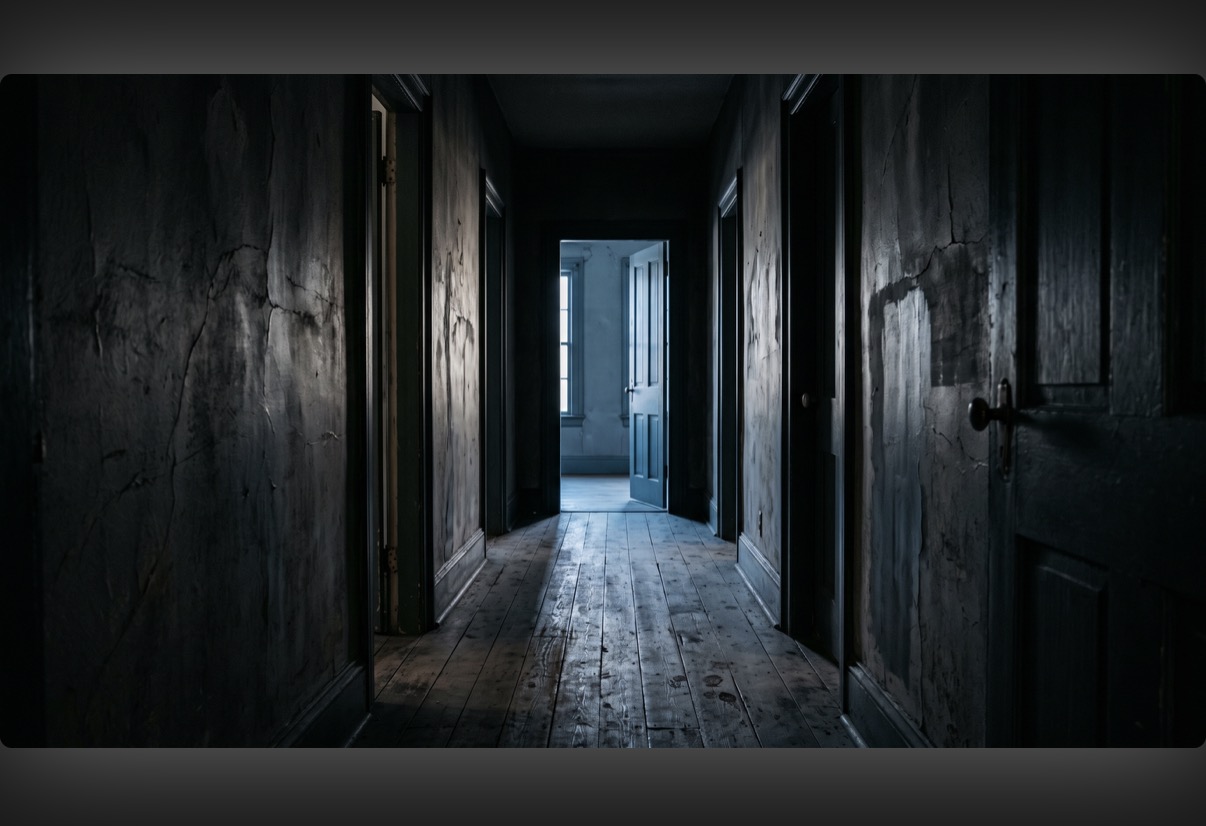
There’s an NF song called “Mansion.” When I hear it, I hear a man who lives inside his own mind like a house. He built walls to stay safe. He paints over the cracks instead of fixing them. There is a room he refuses to walk into, and a room full of regrets, and some of those rooms sit right next to the one where he sleeps. He built a safe room so no one could hurt him, and he admits he chose it. It’s lonely in there. The fear he let in long ago never left. It picked a room and settled in.
The first time I heard it, it was the first time a song made me feel seen.
I know that house. For decades my mind felt like it, with walls covered in old pain and a survival plan that amounted to painting over the cracks. You may know it too. The walls were built for a reason. They kept things out. They also kept you in with the fear and regret you were trying to avoid.
In the quiet, you can finally hear the house.
Gratitude and grief in the same room
Mair and colleagues (2026) read 225 public social media posts from people who found out late in life that they were neurodivergent, mostly autistic, ADHD, or both. They named four themes, which together make up what they call the Grief, Relief, and Belief Cycle: The Life I Could Have Had, Grieving for My Younger Self, Feeling Gratitude, and Post-Diagnosis Burnout.
In the gratitude posts, the diagnosis gave people a new lens, and that lens discouraged shame about their traits. One person described crying, and said it was because they could finally heal. But the gratitude rarely arrived alone. The same posts often described the re-evaluating as exhausting.
That matches my life. In me, the four phases arrive in waves, not in a row. I can feel grief for the child who lined up crayons and gratitude for the adult I’ve become in the same hour. Holding both without the grief taking over may be a sign the identity work is taking hold. That is my reading. These were posts people chose to write, so they can’t tell us how common any of this is.
Three stages, and none of them is a straight line
Bransgrove and Karakas (2025) interviewed eight Australian adults who were diagnosed with autism later in life. They built a three-stage model of identity: pre-identity formation, identity formation, and post-identity formulation. In The Rebuild I use the names Disruption, Negotiation, and Integration, adapted from that model.
Disruption is when the old story cracks. For me it was loudest from September 2025 through about February 2026. My whole pre-diagnosis identity got reframed. I had to face that I had been masking since childhood, and that the lazy, undisciplined, broken story may have been a misreading of how my brain works. Years of stalled routines started to look like what can happen when executive dysfunction goes unexplained.
Negotiation started around March 2026, and I’m still in it. It’s the work of deciding what the new identity looks like. Which masks come off. Which stay. Which behaviors are authentic and which are compensating. Where the hard lines go. Stimming came back. Deadpan humor came back. One morning while I trained, a memory of cut alfalfa came out of nowhere, and with it a grounded, unguarded feeling I hadn’t had since I was a teenager.
Integration is emerging. It looks like holding grief and gratitude together without the grief taking over. It looks like writing all of this down and giving names to Intentional External Scaffolding and Intentional External Friction.
The stages overlap and cycle. Some days I’m living in the third and back in the second by lunch.
The adults in the study named four kinds of support that helped or were missing: social, formal, media, and peer. They also described inadequate professional support and a lack of resources fitted to them. One participant’s words became the paper’s title: being autistic is who you are, an identity more than a disorder. That’s a small study of eight people, so it can’t speak for everyone.
The tired after the quiet
Here’s what surprised me. The quiet wore me out.
Clarey and colleagues (2026) summarize the research on autistic burnout. Reducing masking is often cited as restorative, though some findings suggest that losing the ability to mask may itself be a sign of burnout. Environments that make room for authentic expression seem to help recovery. They also say recovery research remains limited and exploratory.
Mair and colleagues found the same shape. Their fourth theme, Post-Diagnosis Burnout, describes an intense emotional and physical toll and a lack of available support. People pointed to the intensity of the assessment, the trauma it can stir up, and the lack of pathways after the diagnosis, which often left them feeling lost and frustrated.
Those studies are mostly about autistic people. I can’t tell you the same holds for every adult with ADHD. I can tell you that in the first months after my diagnosis, the mask would no longer hold, and the old self didn’t know who he was.
Clearing a room takes fuel
The tired matters for a reason. Rebuilding takes executive function. You have to walk into old rooms, decide what stays, and hold two feelings at once.
The last post covered what research suggests about ADHD: lower dopamine and norepinephrine activity, and differences in the prefrontal networks that plan and start things (Vergara Nieto et al., 2026; Volkow et al., 2011). If that holds for you, this kind of work may be harder to reach on a day your reserves are low. That is my reasoning, not a finding from any study in my files. For me, putting the mask down freed up room I hadn’t known was gone. That’s my experience, and I can’t prove the cause.
What kept me upright was what I set up outside my head. The night-before routine. The phone lockbox. The 5:00 AM anchor. Meals with the decisions already made. Deliberate friction between impulse and avoidance. In The Rebuild these are Intentional External Scaffolding and Intentional External Friction. In my experience they took daily decisions off my prefrontal cortex, so I had some capacity left to open the locked doors and clear the rooms. The steps for each come starting with Chapter 1.
If you are new to heavy lifting, start light and check with your healthcare provider first. Medication decisions belong with your prescriber. Nothing here replaces that conversation.
If you recognize yourself
Some of those rooms don’t empty. Some days the grief comes back as a resident instead of a visitor, and the negotiation opens again. You learn to walk the hallways. You read the walls. You decide what to keep and what to burn.
If you recognize yourself in any of these phases, the grief for the life you could have had, the mourning for the child who didn’t know why everything was so hard, the gratitude for finally understanding, or the burnout from carrying it all without support, then The Rebuild was written for you. I built it from inside the experience.
What follows is mechanical. It’s a system designed by a brain that could not rely on willpower, could not sustain motivation, and could not afford to fail one more time. It’s the missing manual no one gave either of us after the diagnosis.
The song leaves him lonely in the house. I don’t want to leave you there. Chapter 1 starts with a drawer.
Disclaimer: This content is for educational and informational purposes only and does not constitute medical advice, diagnosis, or treatment, nor does it establish a provider-patient relationship. Always seek the advice of a qualified healthcare provider with any questions regarding a medical or mental health condition.
If you or someone you know is struggling or in crisis, help is available: 988 Suicide & Crisis Lifeline (call or text 988, or chat at 988lifeline.org). Crisis Text Line (text HOME to 741741). Veterans Crisis Line (dial 988, then press 1, or text 838255). Emergency: call 911 or go to the nearest emergency room.
Leave a Reply