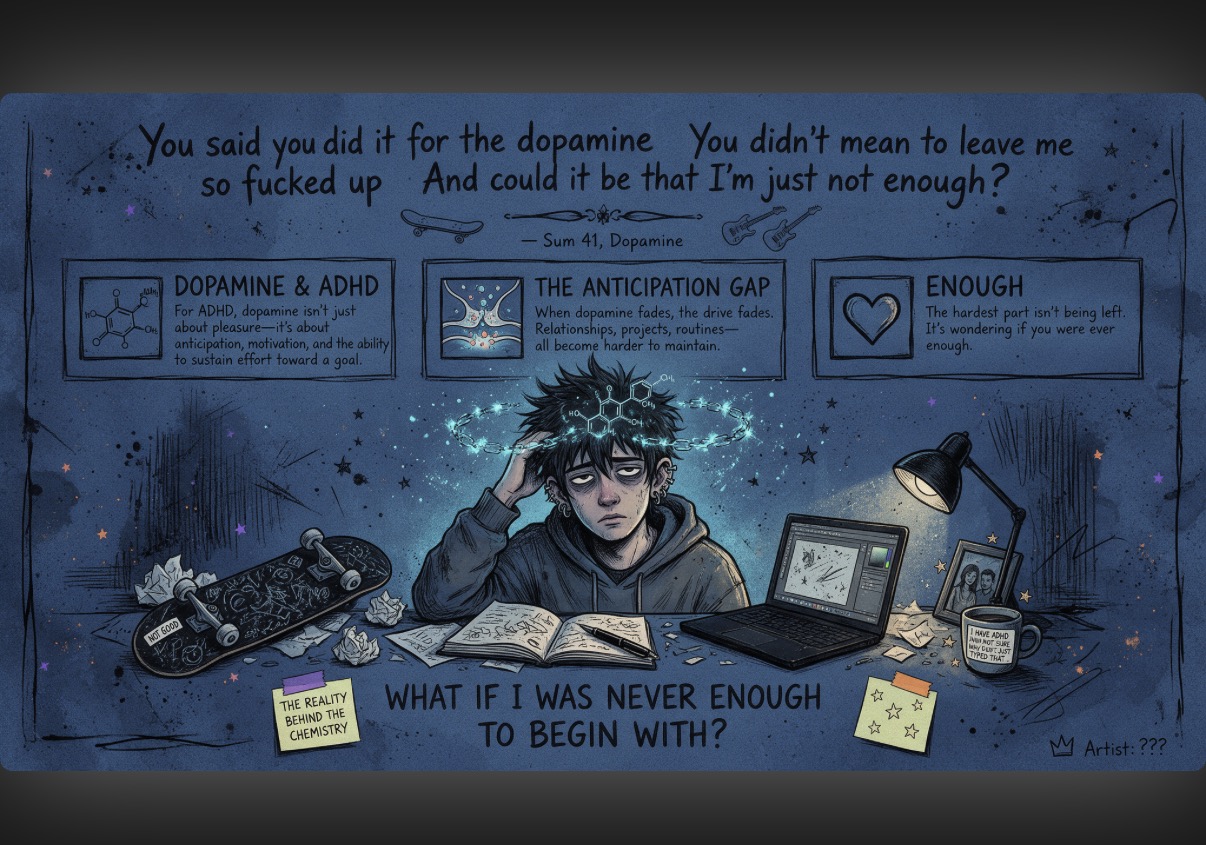
“You said you did it for the dopamine / You didn’t mean to leave me so fucked up / And could it be that I’m just not enough?”
— Sum 41, Dopamine
This song hits different when you understand how dopamine actually works.
The Neuroscience of Wanting
With ADHD, dopamine isn’t about pleasure—it’s about anticipation, motivation, and the ability to sustain effort toward a goal. Volkow and colleagues used PET imaging to demonstrate that adults with ADHD show decreased dopamine receptor and transporter availability in the midbrain and nucleus accumbens—the brain’s reward and motivation centers. The deficit wasn’t in feeling pleasure. It was in wanting—the drive to pursue, to sustain, to follow through.
“It’s so hard to accept / That you’re gone and that’s it / You did it for the dopamine / And it didn’t mean anything at all.”
When the dopamine fades, so does the drive. Relationships, projects, routines—they all become harder to maintain when the neurochemical reward disappears. This isn’t a character flaw. It’s neurology.
The Relational Cost
Henning and colleagues followed adults with ADHD for 15 years and found that inattention symptoms were stably associated with decreased relationship satisfaction and increased perceived stress. The pattern was consistent: when you can’t sustain attention, you can’t sustain connection. When you can’t sustain connection, relationships erode—not because you don’t care, but because your brain doesn’t hold people when they’re not in front of you.
“God, I’ve been up for days / I’ve been losing my mind / Caught up thinking of ways / I could turn back the time.”
That’s the rumination. The AuDHD pattern of replaying, analyzing, trying to figure out what you could have done differently. Time blindness working in reverse—wishing you could go back.
Both Sides of the Pattern
I’ve been on both sides of this song. I’ve been left by people chasing something I couldn’t give them. And I’ve been the one who disappeared—not because I didn’t care, but because my brain couldn’t hold the connection when life got in the way.
“I can picture you in someone else’s place / And he’s got his hands running down your face / Is it in my head ’cause I just can’t let my demons go.”
The intrusive thoughts. The inability to let go. The demons that live in the mansion.
The Hardest Part
The hardest part isn’t being left. It’s wondering if you were ever enough.
And the answer is: you were. The problem was never you. It was the hardware.
This is Where Scaffolding Comes In
If dopamine dysregulation makes it hard to sustain effort, connection, and follow-through, then the environment has to do the work your brain can’t.
Intentional External Scaffolding is the deliberate use of external supports to compensate for internal gaps. For executive dysfunction, that might be checklists, reminders, environment design. For relational maintenance, it might be scheduled check-ins, calendar reminders to reach out, friction that interrupts the automaticity of disconnection.
Intentional External Friction works the other way. If you’re prone to impulsive disconnection—ghosting, withdrawing, disappearing when things get hard—friction can slow that process down. A commitment to a weekly call. A shared calendar. An accountability partner who asks “have you reached out to anyone this week?”
“Told me time and again you don’t believe in the past / It was us against them but nothing good could last.”
The connections you lost weren’t lost because you didn’t care. They were lost because your brain doesn’t hold people when they’re not in front of you. That’s not a character flaw. That’s neurology. And now that you know, you can build scaffolding to compensate—reminders, scheduled check-ins, friction that interrupts the automaticity of disconnection.
The Grief, Relief, and Belief Cycle
Mair and colleagues studied late-diagnosed neurodivergent adults and found that post-diagnostic identity work cycles through four phases: The Life I Could Have Had, Grieving for My Younger Self, Feeling Gratitude, and Post-Diagnosis Burnout. The grief isn’t just for the diagnosis—it’s for the relationships you couldn’t maintain, the connections you lost, the people you loved and then disappeared from.
“I guess you threw it away / I don’t know who to blame / Leave it all at a day / And just put out the flame.”
The grief is real. The guilt is real. But the diagnosis gives you language. And language gives you tools. And tools give you scaffolding. And scaffolding holds when the feeling fades.
The Feeling Fades. The Scaffolding Holds.
If you’ve been on either side of this song—left by someone chasing a feeling, or being the one who disappeared—you’re not broken. You’re operating with different hardware. And now that you know, you can build systems that compensate for what your brain can’t do on its own.
This post is not medical advice. If you or someone you know is in crisis, please contact the 988 Suicide & Crisis Lifeline (call or text 988) or go to your nearest emergency room.
Dylan Kratochvil, MSN, NP-C | Founder, Strength Protocol. An environment-first behavioral weight management and lifestyle medicine clinic for adults with ADHD. Explore the protocol, review the syllabus, or begin your clinical intake: strength-protocol.com
Leave a Reply